Woman in a purple fleece workout top, stretching her arm.

Vitamins for Bone Health Support: Our Expert Advice

Nov 13, 2025 Bone Health articles Calcium articles Magnesium articles Vitamin D articles Vitamin K articles
6 MIN

Woman in a purple fleece workout top, stretching her arm.

Our bodies wouldn’t get far without bones. They’re the framework that keeps everything moving.

Bone health is important for your overall well-being and plays a key role in mobility, strength, and longevity.

So, how can you support these bones we love so much? Important nutrients, both vitamins and minerals, help the body build and maintain healthy bones. Adequate calcium and vitamin D as part of a healthful diet, along with physical activity, may reduce the risk of osteoporosis in later life.

You can support your bones with daily nutrients, whether through dietary sources or daily bone health supplements. Consistency is key; if you're taking bone health supplements, try attaching them to a regular mealtime like breakfast or dinner to help you keep a consistent daily intake of bone health nutrients. Let’s now dive into a bit of science behind bones.

The Science Behind Minerals, Vitamins, and Bone Health

Various vitamins and minerals play key roles in supporting bone structure and function. As our bones grow, they undergo a process called mineralization, depositing calcium in crystalline structures that keep our bones strong. This process requires several vitamins and minerals, as it's how calcium builds bone tissue.[1]

Many other nutrients help with the absorption of calcium, which supports mineralization and bone health over time. While a balanced diet can help us get these nutrients, many people don't get enough of all the vitamins and minerals needed to support bone health through diet alone.[2]

The amount of bone health nutrients required can also be influenced by lifestyle and your life stage. For example, women need more calcium post-menopause, and active individuals may need to increase their intake of bone health nutrients. These individuals may benefit from additional supplementation, helping to round out their diet with additional bone health nutrients. Let’s dig into the essential minerals and vitamins for bone health.

The Essential Players in Bone Health

Vitamin D

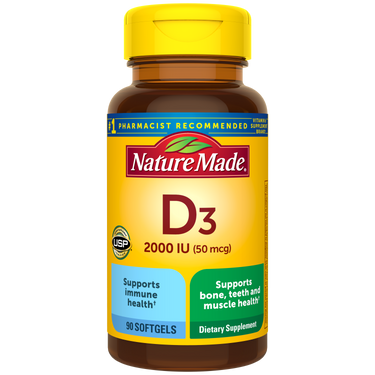
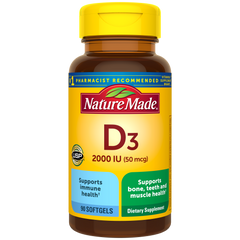
Vitamin D, also known as the sunshine vitamin, is a nutrient we mostly get from exposing our skin to sunlight, without sunscreen, of course. So, what links this vitamin and bone health together? Vitamin D helps the body absorb calcium from dietary sources, which is critical for bone strength. Nature Made Vitamin D Softgels support bone, teeth, muscle and immune health in only one daily supplement.†

Vitamin K

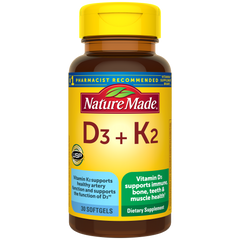
Vitamin K activates certain proteins that play a critical role in bone mineralization.[3] This process is aided by vitamin D, as vitamin K2 and D3 work together to support strong and healthy bones. Get both of these vitamins for bone health support in one supplement with our Vitamin D3 + K2 Softgels.†

Calcium

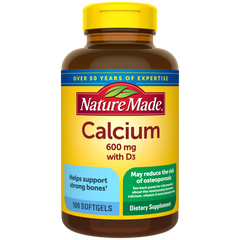
Calcium, found in dairy products, is one of the most prominent bone health nutrients. Calcium is the most abundant mineral in our bodies, and most of it is found in our bones due to its role in supporting bone mass and strength. Adequate calcium throughout life, as part of a well-balanced diet, may reduce the risk of osteoporosis. Nature Made Calcium Softgels include vitamin D to help improve calcium absorption.†

Magnesium

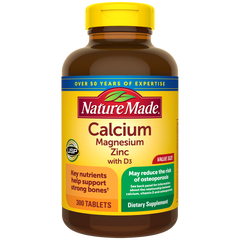
Magnesium is another essential mineral that supports your bones; it plays a role in the function of the cells that form and break down the bones in your body.[4] Magnesium helps support bone health, along with muscle, nerve, and heart health. Prioritize your bone health with Nature Made Calcium, Magnesium and Zinc with Vitamin D3, with important nutrients to help support strong bones.†

How to Choose the Right Minerals and Vitamins for Bone Health Support

What's the best way to find the right minerals and vitamins to support bone health? Consulting with a trained medical professional! It's always best to ask your primary healthcare practitioner when considering starting or changing a supplement routine; they are equipped with personal knowledge of your unique circumstances, including age, lifestyle, and health conditions, that may factor into your supplement needs. A trusted healthcare professional can help you identify any potential key areas to support and help you assemble a dietary and supplementary routine to help address them.

Foods vs. Supplements: What's the Difference?

What's the difference between getting nutrients in foods vs supplements? Generally, it's best to aim to get as many essential nutrients through your daily food intake as you can. How to get calcium for bones in food sources, along with other bone health nutrients?

  • Calcium: Dairy products like milk, yogurt and cheese. Also found in legumes and green vegetables like broccoli and kale.
  • Vitamin D: Vitamin D is mostly produced in response to sunlight but can be found in certain fatty fish and egg yolks and it is often fortified in milk.
  • Vitamin K2: Found in small amounts in liver, some cheeses, and fermented soybeans.
  • Magnesium: Found in many plant foods including whole grains, dark green leafy vegetables, nuts, and beans.

Getting a well-balanced diet filled with nutrient-dense foods is a great way to support your daily wellness and overall health. However, sometimes that can be difficult. Whether due to dietary restrictions, a lack of availability of certain foods, age, or conditions that reduce nutrient absorption, supplementation can help to bridge possible nutrient gaps.

Nature Made supplements are made with high-quality, science-backed ingredients to help provide you with a convenient, daily source of essential nutrients.

Common Myths About Vitamins for Bone Health Support– Debunked by Experts

Nowadays, it isn't always easy to sort out the truth from myths. Let's address some common misconceptions about minerals and vitamins for bone health so that you can make informed decisions as an educated consumer.

Myth: "Calcium Alone is Enough for Strong Bones"

Calcium may be the most famous bone health nutrient, but that doesn't mean it's the only nutrient your bones need. In addition to calcium, vitamin D, magnesium, and vitamin K are all major players when it comes to supporting your bones. Consuming vitamins and minerals is just one of the many ways to give your bones support – they also benefit from being challenged by weight-bearing activities like walking and strength training. So while calcium is great for supporting strong bones, you can see why vitamin D and calcium for bone health should be just one part of a well-rounded routine.

Myth: "You Don't Need Supplements if You Eat Healthy"

Eating a balanced diet is the ideal way to support your body with essential nutrients. However, even a balanced diet might not always provide sufficient levels of specific vitamins depending on your age, lifestyle, or certain health conditions.

For example, vitamin D is mainly produced in response to sunlight and is found only in limited food sources (like fatty fish and fortified milk). Even if you regularly eat fruits, vegetables, whole grains, and lean protein, if those vitamin D-rich foods aren’t consistently on your plate, you may not meet the daily recommended amount – especially if your exposure to sunlight is limited due to climate or lifestyle, or if you are always wearing sunscreen. Consulting with a trusted medical professional can help you determine whether supplements may be a good part of your daily wellness routine.

Supplements are not a replacement for a balanced diet, and do not support healthy bones alone. For healthy bones, focus on a nutrient-dense diet, resistance and strength training, and healthy lifestyle choices like avoiding smoking and overconsumption of alcohol – then consider supplements for additional support.[5,6]

Myth: "Vitamins Work Instantly"

Consistency, consistency, consistency. Supporting your bone health with vitamins is not a one-time, instant thing. Supplements work best when they're taken consistently, providing your body with a daily source of essential nutrients. Building and maintaining strong bones doesn't happen overnight; it's a long-term process. Supporting your bones with consistent vitamins and minerals helps support strong and healthy bones over time, not immediately.

The best way to establish a consistent supplement routine is by adding it to a pre-existing habit, like with your favorite meal, maybe at breakfast or dinner. This has a couple of benefits: first, it makes remembering to take your supplements easier because it happens at the same time every day, and second, many vitamins and minerals should be taken with water and a meal to help absorption. By attaching your supplement routine to a regular mealtime, you ensure that properly taking supplements is easy.

Trust in Pharmacist-Recommended Vitamins for Bone Health

Vitamins and minerals are one part of a comprehensive approach to bone health, and bone support supplements are a convenient way to support your healthy lifestyle with consistent essential nutrients.

If you're interested in vitamins for bone health from a trusted brand, explore Nature Made's Bone Health Supplements to help you reach your personal health goals as part of a healthy lifestyle. Nature Made is the #1 Pharmacist Recommended Vitamin & Supplement Brand.*†


*Based on a survey of pharmacists who recommend branded vitamins and supplements.


† These statements have not been evaluated by the Food and Drug Administration. These products are not intended to diagnose, treat, cure, or prevent any disease.


References

  1. National Institute of Health. Calcium. Nih.gov. Published July 24, 2024. https://ods.od.nih.gov/factsheets/Calcium-HealthProfessional/
  2. Reider CA, et al. Inadequacy of Immune Health Nutrients: Intakes in US Adults, the 2005-2016 NHANES. Nutrients. 2020 Jun 10;12(6):1735.
  3. Akbari S, Rasouli-Ghahroudi AA. Vitamin K and Bone Metabolism: A Review of the Latest Evidence in Preclinical Studies. Biomed Res Int. 2018;2018:4629383. Published 2018 Jun 27. doi:10.1155/2018/4629383
  4. National Institutes of Health. Magnesium. National Institutes of Health. Published June 2, 2022. https://ods.od.nih.gov/factsheets/Magnesium-HealthProfessional/
  5. Al-Bashaireh AM, Haddad LG, Weaver M, Kelly DL, Chengguo X, Yoon S. The Effect of Tobacco Smoking on Musculoskeletal Health: A Systematic Review. J Environ Public Health. 2018;2018:4184190. Published 2018 Jul 11. doi:10.1155/2018/4184190
  6. Eby JM, Sharieh F, Callaci JJ. Impact of Alcohol on Bone Health, Homeostasis and Fracture repair. Curr Pathobiol Rep. 2020;8(3):75-86. doi:10.1007/s40139-020-00209-7

Authors

Graham Morris

NatureMade Copywriter

Graham has a degree in film with a focus on screenwriting from the University of California, Santa Cruz. He enjoys learning new things and finding the best, most engaging way to communicate them to a wide audience. Graham appreciates simplicity in life and nutrition, and wants to find the easiest, no-stress ways to stay healthy.

Read More about Graham Morris

Kalyn Williams, RDN

Science and Health Educator

Kalyn is a Registered Dietitian-Nutritionist and a Science & Health Educator with the Medical and Scientific Communications team at Pharmavite. Her experience in the field of nutrition prior to joining Pharmavite has included community and public health education, media dietetics, and clinical practice in the areas of disordered eating, diabetes, women’s health, and general wellness. Kalyn received her Bachelor of Science degree in Nutrition and Dietetics from Arizona State University in Phoenix, Arizona, and completed her dietetic supervised practice in Maricopa County, AZ, with an emphasis on public health. Kalyn is certified in Integrative and Functional Nutrition through the Academy of Nutrition and Dietetics, where she is an active member in addition to memberships in Dietitians in Functional Medicine, Women’s Health Dietitians, and the International Federation of Eating Disorder Dietitians.

Read More about Kalyn Williams, RDN