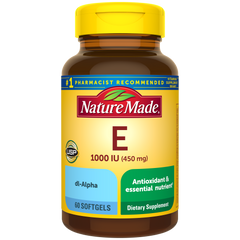
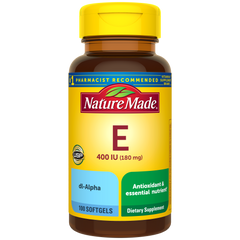
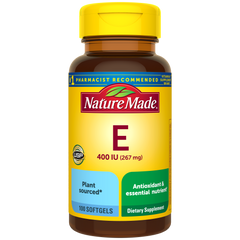
Nature Made Vitamin E supplements displayed with avocado and water, highlighting antioxidant support for skin health.

What to Know About Vitamin E for Skin: Benefits, Sources, and Science

Feb 25, 2026 General Beauty articles Healthy Skin articles Vitamin E articles
5 MIN

Nature Made Vitamin E supplements displayed with avocado and water, highlighting antioxidant support for skin health.

Skin health is something we all think about, especially as we age. Our skin is the largest organ in the body, and it’s the most outward facing, so finding ways to take care of your skin from within and without is often a priority. But did you know that vitamin E is one of the vitamins for skin health support? Vitamin E is an essential vitamin that's found in a number of foods and supplements, including multivitamins, single vitamin E skin support supplements, and ingredient blends.

But what exactly does vitamin E do? Vitamin E is an antioxidant that supports healthy skin and healthy aging. We’ll explore how vitamin E supports skin health, the mechanisms by which it works in the body, and what our science experts have to say about its role in supporting skin health.

What Is Vitamin E?

Vitamin E for skin is one of the many essential vitamins that we need to get through diet or supplementation to support our body. But what sets it apart? Vitamin E is a fat-soluble nutrient. You may be familiar with fat-soluble and water-soluble nutrients, but if not, the key difference is that fat-soluble nutrients require some sort of dietary fat, like oil or butter, in order to be absorbed.

Vitamin E functions in the body as an antioxidant, a molecule that neutralizes free radicals generated by cellular metabolism, helping protect the body from oxidative stress. Beyond that, vitamin E is an essential nutrient that plays a role in the function of many different cells and supports healthy aging and a healthy immune system.

What Are the Benefits of Vitamin E for Skin?

If you’re looking into skin support supplementation, you’re probably curious about vitamin E benefits for skin health. Vitamin E is found in the dermis and the epidermis, the two primary layers of our skin. This essential nutrient dissolves into the lipid matrix that makes up the outer layer of our skin, penetrating deeper layers.[1] Vitamin E supports healthy aging and healthy skin, but what does vitamin E do for your body?

Supports Healthy Skin

Vitamin E is an antioxidant that helps protect against free radicals. It works together with vitamin C, another antioxidant, to help protect skin from oxidative stress. Oxidative stress occurs when free radicals, or molecules with unpaired electrons, are generated from the breaking and forming of bonds that happen during cellular processes. These molecules ping around in the body, and can cause effects like cellular stress, until they’re bonded with another molecule, namely an antioxidant like vitamin E or vitamin C.[2]

While vitamin E supports skin health and functions as an antioxidant, it is not a substitute for sunscreen, so remember to stay diligent about applying sunscreen to protect your skin from UV rays. And never forget the importance hydration plays in skin health; be sure to drink adequate amounts of water at regular intervals throughout the day, as water is a key component in supporting skin health and appearance.

How to Choose a Vitamin E Supplement

The supplement market provides plenty of options for vitamin E, including topical and oral forms. How do you pick the right vitamin E supplement for you? Choosing a trusted brand like Nature Made lets you know you’re getting a dietary supplement made with high-quality ingredients that are backed by science. Our Vitamin E supplement includes clearly labeled ingredients, dosage, and percentage of daily value, so you know what you're getting, and how much of it you are getting per dose.

Nature Made Vitamin E supports healthy aging and healthy skin, providing a source of this essential nutrient for many cells, including heart muscle cells. Vitamin E supports a healthy immune system and functions as an antioxidant that neutralizes free radicals in the body.

One thing you should consider when picking a vitamin E supplement is dosage. Nature Made offers Vitamin E supplements in 400 IU and 1000 IU dosages. Vitamin E also comes in the forms of dl-Alpha and d-Alpha. These are both effective forms of vitamin E supplementation. Vitamin E d-Alpha is the most bioavailable form of vitamin E.

How much vitamin E per day should you take? Since individual needs can vary based on diet and lifestyle, your doctor can help determine your nutrient needs.

Consider whether you are looking for targeted, single-nutrient supplementation, like a vitamin E softgel, or for vitamin E supplementation alongside a wide base of nutrients, like in our Advanced Multivitamin Gummies for Women and for Men, or even in a supplement blend supporting your beauty from within in our Zero Sugar Hair Skin Nails Gummies.

Nature Made Vitamin E supplements provide daily doses within the upper limit of vitamin E for adults, which is 1,000 mg per day.[3] Speak to your healthcare provider before adding a vitamin E supplement to your routine.

Food Sources of Vitamin E

Where do we get vitamin E in our diet? A valid question, seeing as 84% of US adults have a nutrient shortfall for Vitamin E.[4] Foods like almonds, sunflower seeds, spinach, avocado, and peanut butter contain vitamin E.

Adding vitamin E foods to your diet can be a flavorful addition. Toss some sliced almonds into your next salad for a tasty crunch or drizzle sunflower oil as a garnish. And who could say no to an avocado? Assess the vitamin E levels included in your diet, and whether supplementing these dietary sources with a daily supplement could provide vitamin E benefits and help support adequate intake, supporting your skin from within.

Ready to Support Your Skin Health with Vitamin E?

Vitamin E may not be the trendiest nutrient, but that doesn’t mean you should forget about it. Consider your vitamin E intake when putting together a well-rounded skincare routine; it’s an essential nutrient that supports healthy skin and healthy aging.

Take an active approach on how to take care of your skin, educate yourself on vitamin E benefits for skin, and consult your doctor to see whether supplementation may benefit your daily routine. Because vitamin E is a fat-soluble nutrient, always take vitamin E with a meal including a dietary fat to aid in proper absorption.

If you’re ready to explore vitamin E for skin health, consider Nature Made Vitamin E Softgels—crafted to deliver high-quality support for your wellness journey. Additionally, our Vitamin C Supplements provide a wide range of options for those looking to support their body with another essential vitamin, one that works closely with vitamin E as an antioxidant to help protect our cells from oxidative stress. Explore your options today!

References:

  1. Vitamin E and Skin Health. Linus Pauling Institute. Published January 2, 2019. Accessed December 18, 2025. https://lpi.oregonstate.edu/mic/health-disease/skin-health/vitamin-E
  2. Chandimali, N., Bak, S.G., Park, E.H. et al. Free radicals and their impact on health and antioxidant defenses: a review. Cell Death Discov. 11, 19 (2025). Accessed December 18, 2025. https://doi.org/10.1038/s41420-024-02278-8
  3. National Institutes of Health. Office of Dietary Supplements - Vitamin E. Nih.gov. Published 2021. Accessed December 18, 2025. https://ods.od.nih.gov/factsheets/VitaminE-HealthProfessional/
  4. Reider CA, Chung RY, Devarshi PP, Grant RW, Hazels Mitmesser S. Inadequacy of Immune Health Nutrients: Intakes in US Adults, the 2005-2016 NHANES. Nutrients. 2020;12(6):1735. Published 2020 Jun 10. doi:10.3390/nu12061735. Accessed December 18, 2025. https://pubmed.ncbi.nlm.nih.gov/32531972/

Not a low calorie food

† These statements have not been evaluated by the Food and Drug Administration. These products are not intended to diagnose, treat, cure or prevent any disease.

Authors

Graham Morris

NatureMade Copywriter

Graham has a degree in film with a focus on screenwriting from the University of California, Santa Cruz. He enjoys learning new things and finding the best, most engaging way to communicate them to a wide audience. Graham appreciates simplicity in life and nutrition, and wants to find the easiest, no-stress ways to stay healthy.

Read More about Graham Morris

Kalyn Williams, RDN

Science and Health Educator

Kalyn is a Registered Dietitian-Nutritionist and a Science & Health Educator with the Medical and Scientific Communications team at Pharmavite. Her experience in the field of nutrition prior to joining Pharmavite has included community and public health education, media dietetics, and clinical practice in the areas of disordered eating, diabetes, women’s health, and general wellness. Kalyn received her Bachelor of Science degree in Nutrition and Dietetics from Arizona State University in Phoenix, Arizona, and completed her dietetic supervised practice in Maricopa County, AZ, with an emphasis on public health. Kalyn is certified in Integrative and Functional Nutrition through the Academy of Nutrition and Dietetics, where she is an active member in addition to memberships in Dietitians in Functional Medicine, Women’s Health Dietitians, and the International Federation of Eating Disorder Dietitians.

Read More about Kalyn Williams, RDN