how much collagen should i take

How Much Collagen Should You Take Per Day?

Jun 30, 2026 Collagen articles General Beauty articles
6 MIN

how much collagen should i take

Quick Scoop

  • Collagen is one of the primary proteins in the body
  • Collagen makes up about 90% of your hair, skin, and nails
  • People might explore collagen supplements because collagen is found only in limited food sources, such as animal skin, bones, and tendons

Are you considering adding a collagen supplement to your daily regimen? Collagen is a popular ingredient found in many dietary supplements.

As a naturally occurring protein in the body, collagen plays a vital role in healthy hair, skin, and nails. In fact, the body produces more than two dozen types of collagen, and it's one of the primary proteins in the body.[1]

But collagen does more than just support healthy hair, skin, and nails. Collagen’s important roles in the body include:[1,2]

  • making up the building blocks of bones, connective tissue, fibrous cartilage, ligaments, organs, skin, teeth, and tendons
  • supporting healthy joints
  • supporting healthy arteries, organs, and muscles

Specific types of collagen work in different parts of the body. For instance, types I and III collagen make up 90% of your hair, skin, and nails, supporting the strength of your hair and nails.

Did you know that as early as your 20s, you start losing about one percent of collagen per year,[3] Collagen production can slow as much as 30% during the first five years of menopause, which is why many women look to collagen benefits from supplementation.[4]

Your body continues to produce collagen, but the rate slows, so the level of collagen in your body lowers over time. It makes sense, then, to wonder, “Should I take collagen?” And if so, how much collagen per day has been studied?

Let’s find out.

How Much Collagen Should You Take a Day?

While you should always look to healthy food sources first to get the nutrients you need, getting adequate collagen regularly through your diet might pose a challenge. Why? Because collagen food sources are somewhat limited. Collagen comes from the skin, bones, tendons, and ligaments of animals and fish—with the highest amounts often in animal parts not typically consumed in the Western diet (think ligaments, organ meats, and tendons). Since only a few animal foods naturally contain collagen, you’ll need to eat a variety of animal- and plant-based foods that support collagen production in the body, including foods high in protein, vitamin C, zinc, and copper.[1,5,6]

Food sources of collagen are not abundant in the standard western diet, which is why many people look to supplements. But how much collagen should you take? Because your body produces collagen, the recommended amount of collagen to take will vary from person to person. Collagen is generally well-tolerated and considered safe when taken as instructed and subject to any cautionary language.

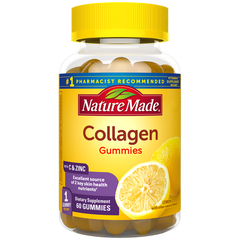
Collagen supplements are available in many forms, like Nature Made Collagen Peptides + C Gummies and Collagen Peptides Powder; it's important to read the benefits each supplement targets, follow the "Suggested Use" for dosage, and discuss collagen intake with your healthcare practitioner.

Looking for joint health support? Our Collagen Drink Mix Powder provides 11 g of collagen peptides per daily serving, including 5 g of a clinically studied collagen ingredient to support your joints.▴▪️ Always follow the dosage instructions and "Suggested Use" on your collagen supplement label. Consult with a doctor or trusted healthcare professional before adding any supplement to your daily routine.

How much collagen per day should I take for skin health?

Research shows that daily consumption of certain kinds of collagen peptides helps support your healthy skin.[7-10] Nature Made offers Collagen Peptides + C Gummies provide 2.5 g of clinically studied Verisol® collagen peptides per daily serving to support your body’s skin collagen production.

The Main Forms of Collagen in Supplements

Hydrolyzed Collagen

Also known as collagen peptides, hydrolyzed collagen is commonly found in many collagen supplements and collagen-enriched foods, often in the form of powder or capsules. Why? Long-chain collagen proteins are difficult for the body to absorb, so they are broken down by a process called hydrolysis into short-chain amino acids, which are more easily absorbed by the body. The collagen peptides include in Nature Made Collagen Peptides + Vitamin C Gummies are clinically studied to support skin benefits, and they include vitamin C, which supports collagen production.

The best advice for how much collagen to take per day? Follow the supplement’s "Suggested Use," which gives clear instructions for dosage and proper consumption.

When it comes to timing, should you take collagen in the morning or night? Read our article, When Should I Take Vitamins? for more information on timing your supplements.

The Benefits of Collagen Peptides

Collagen Peptides are an ingredient that has been clinically studied to support different health goals. Nature Made offers collagen products to support joint and skin health.

Nature Made Collagen Peptides Drink Mix Powder includes 5 g of a clinically studied collagen ingredient, which helps support healthy joints and joint comfort.▴▪️ This sugar free supplement also includes biotin, an essential vitamin, to support healthy hair, skin and nails. With 1 daily scoop mixed into water or other beverages, this supplement is non-dairy, has no soy, and is keto friendly.

Our Collagen Peptides + C Gummies provide Verisol® collagen, which is a clinically studied ingredient that helps reduce fine lines and wrinkles around the eyes (also known as crow's feet) in as little as 4 weeks and supports healthy skin and elasticity.§ A double-blind study found that benefits started in as little as four weeks, and after 8 weeks, the collagen benefits were even more pronounced.[11]†

These gummies also include essential vitamin C, which helps your body produce collagen to support healthy skin. Including foods with vitamin C in your diet, or vitamin C supplements, in your daily routine can help support your skin from within.

Collagen FAQs

What are the benefits of taking collagen with biotin?


Nature Made Collagen Peptides Drink Mix Powder includes 5 g of a clinically studied collagen ingredient to support healthy joints and joint comfort.▴▪️ Including biotin in this supplement supports healthy hair, skin, and nails, providing more support for your daily wellness regimen.

How long does it take to see results from collagen peptides?

Like most supplements, it's important to take collagen supplements consistently. Nature Made Collagen Peptides + C Gummies include Verisol® collagen, which has been clinically studied on women ages 35-55, helping to reduce crow's feet around the eye in as little as 4 weeks and supporting skin health and elasticity.

How Much Collagen Is Too Much?

Collagen supplements are generally well tolerated and considered safe when taken as instructed and subject to any cautionary labeling. Of course, you should always stay within the recommended dosages of the product packaging and consult a healthcare professional before starting a collagen supplement.

The Bottom Line

If you want to help support joint and skin health, collagen is a critical element in these roles. While your body produces collagen, production declines as you get older. And because it's not always easy to get collagen through our daily diet, a supplement might be a good way to go. How much collagen per day to take depends on its form and why you want to take it. Your best bet? Follow the package directions.

Explore a wide range of supplement options from Nature Made, the #1 Pharmacist Recommended Vitamin & Supplement Brand.*

Learn More About Vitamins & Supplements:


Verisol® is a registered trademark of GELITA AG.

▴In active young adults.

▪️Blend consists of two collagen peptide ingredients.

◆ Not a low calorie food.

‡This product contains 0 g net carbs per serving.

♢studied on crow's feet in women ages 35-55

§in women

* Based on a survey of pharmacists who recommend branded vitamins and supplements.


References:

  1. Cleveland Clinic. Collagen: What It is, Types, Function & Benefits. Cleveland Clinic. Published 2022. Accessed December 16, 2025. https://my.clevelandclinic.org/health/articles/23089-collagen
  2. Wang H. A Review of the Effects of Collagen Treatment in Clinical Studies. Polymers (Basel). 2021;13(22):3868. Published November 9, 2021. doi:10.3390/polym13223868 Accessed December 16, 2025. https://pubmed.ncbi.nlm.nih.gov/34833168/
  3. Ganceviciene R, Liakou AI, Theodoridis A, Makrantonaki E, Zouboulis CC. Skin anti-aging strategies. Dermatoendocrinol. 2012;4(3):308-319. doi:10.4161/derm.22804 Accessed December 16, 2025. https://pmc.ncbi.nlm.nih.gov/articles/PMC3583892/
  4. Collagen Products: Healthy or Hype? Cedars-Sinai. Published November 5, 2025. Accessed December 16, 2025. Accessed https://www.cedars-sinai.org/blog/collagen-supplements.html
  5. Harvard T.H. Chan School of Public Health. Collagen. The Nutrition Source. Published May 26, 2021. Accessed December 16, 2025. https://nutritionsource.hsph.harvard.edu/collagen/
  6. Vo J. Nutrition & Health Info Sheets for Health Professionals - Protein Requirements. UC Davis Nutrition Department. Published June 25, 2020. Accessed December 16, 2025. https://nutrition.ucdavis.edu/outreach/nutr-health-info-sheets/pro-protein-requirements
  7. Paul C, Leser S, Oesser S. Significant Amounts of Functional Collagen Peptides Can Be Incorporated in the Diet While Maintaining Indispensable Amino Acid Balance. Nutrients. 2019;11(5):1079. Published May 15, 2019. doi:10.3390/nu11051079 Accessed December 16, 2025. https://pubmed.ncbi.nlm.nih.gov/31096622/
  8. Bolke L, Schlippe G, Gerß J, Voss W. A Collagen Supplement Improves Skin Hydration, Elasticity, Roughness, and Density: Results of a Randomized, Placebo-Controlled, Blind Study. Nutrients. 2019;11(10):2494. Published October 17, 2019. doi:10.3390/nu11102494 Accessed December 15, 2025. https://pubmed.ncbi.nlm.nih.gov/31627309/
  9. Proksch E, Schunck M, Zague V, Segger D, Degwert J, Oesser S. Oral intake of specific bioactive collagen peptides reduces skin wrinkles and increases dermal matrix synthesis. Skin Pharmacol Physiol. 2014;27(3):113-119. doi:10.1159/000355523 Accessed December 16, 2025. https://pubmed.ncbi.nlm.nih.gov/24401291/
  10. Schauss AG, Stenehjem J, Park J, Endres JR, Clewell A. Effect of the novel low molecular weight hydrolyzed chicken sternal cartilage extract, BioCell Collagen, on improving osteoarthritis-related symptoms: a randomized, double-blind, placebo-controlled trial. J Agric Food Chem. 2012;60(16):4096-4101. doi:10.1021/jf205295u Accessed December 16, 2025. https://pubmed.ncbi.nlm.nih.gov/22486722/
  11. Proksch E, Zdzieblik D, Oesser S. The Oral Intake of Specific Bovine-Derived Bioactive Collagen Peptides Has a Stimulatory Effect on Dermal Matrix Synthesis and Improves Various Clinical Skin Parameters. Cosmetics. 2025; 12(2):79. Accessed December 16, 2025. https://doi.org/10.3390/cosmetics12020079

† These statements have not been evaluated by the Food and Drug Administration. These products are not intended to diagnose, treat, cure or prevent any disease.

Authors

Lisa Beach

NatureMade Contributor

Lisa Beach is a seasoned journalist whose work has been published in The New York Times, Good Housekeeping, Eating Well, Parents, AARP’s Disrupt Aging, Optimum Wellness, and dozens more. She also writes for a variety of health/wellness-focused brands. Check out her writer’s website at www.LisaBeachWrites.com.

Read More about Lisa Beach

Kalyn Williams, RDN

Science and Health Educator

Kalyn is a Registered Dietitian-Nutritionist and a Science & Health Educator with the Medical and Scientific Communications team at Pharmavite. Her experience in the field of nutrition prior to joining Pharmavite has included community and public health education, media dietetics, and clinical practice in the areas of disordered eating, diabetes, women’s health, and general wellness. Kalyn received her Bachelor of Science degree in Nutrition and Dietetics from Arizona State University in Phoenix, Arizona, and completed her dietetic supervised practice in Maricopa County, AZ, with an emphasis on public health. Kalyn is certified in Integrative and Functional Nutrition through the Academy of Nutrition and Dietetics, where she is an active member in addition to memberships in Dietitians in Functional Medicine, Women’s Health Dietitians, and the International Federation of Eating Disorder Dietitians.

Read More about Kalyn Williams, RDN