When to Take Ashwagandha: What's the Best Time?

When to Take Ashwagandha: What's the Best Time?

May 31, 2026 Ashwagandha articles FAQs articles Stress articles
5 MIN

When to Take Ashwagandha: What's the Best Time?

Quick Health Scoop:

  • The roots and leaves of the Ashwagandha plant (Withania somnifera) have long been used in Ayurvedic medicine to help support stress relief
  • Nature Made® offers two clinically studied forms: KSM-66® Ashwagandha and Sensoril® Ashwagandha
  • The best time to take ashwagandha depends on your health goals, the type of ashwagandha you take, and the product’s dosing instructions — for example, ashwagandha paired with magnesium can be a good fit for an evening routine to help relax the body

Ashwagandha (sometimes called Indian Ginseng or Winter Cherry) is a small shrub whose roots and leaves have long been used in Ayurvedic medicine as an adaptogen — meaning it helps the body adapt to stressors over time. When taken as a standardized extract, ashwagandha helps reduce perceived stress and cortisol levels, which is why it has become one of the most popular ashwagandha stress relief supplements available today.

When is the best time to take ashwagandha? Does the time of day matter when taking ashwagandha supplements for stress? That depends on a few factors: the type of ashwagandha extract in your supplement, the product’s dosing instructions and your personal wellness goals. As always, consult your healthcare practitioner to determine whether ashwagandha fits your daily routine.

Learn More: Causes of Stress & How the Body Reacts

What are the Benefits of Ashwagandha?

We already learned that ashwagandha helps reduce cortisol and perceived stress but what else does it do?

Ashwagandha benefits come from its role as an adaptogen. Adaptogenic herbs help impact the body’s response to stressors over time. They do this by helping restore balance to the body’s stress response, and the release of hormones by the communication system between the brain and adrenal glands called the hypothalamus-pituitary-adrenal axis.[1]

When we are stressed, our body activates a “fight or flight” response by releasing the “stress hormone” cortisol from our adrenal glands. Clinical studies show that ashwagandha, when taken as a standardized extract consistently over a period of time, can help restore balance to the adrenals by reducing perceived stress and cortisol levels. Clinically studied ashwagandha KSM-66® and Sensoril® extracts help reduce occasional anxiousness and when taken consistently over time, work with your body to help support sleep quality.

Practicing stress management techniques can help you manage daily stressors, and adaptogen supplementation can help when taken consistently. Not all ashwagandha supplementation is the same, however, as the benefits are determined by the type of extract used and the dosage.

Learn More: Ashwagandha Benefits

What are the Different Types of Ashwagandha?

The roots and leaves of ashwagandha are typically used in extracts. The main bioactive compound of ashwagandha is a group called withanolides, and these are what help support the health benefits a user would be looking for when taking an Ashwagandha supplement. This herb is commercially available as ashwagandha tablets, capsules, and powders.

Nature Made uses two forms of ashwagandha extract:

  • KSM-66® Ashwagandha: A clinically studied ashwagandha root extract that is standardized to 5% withanolides. When used in dietary supplements, a dose of 300 mg per day has been shown in clinical studies to help reduce stress. Additionally, at this dosage, KSM-66® ashwagandha works with your body over time to help support sleep quality. Nature Made Ashwagandha Gummies provide 300mg of KSM-66® ashwagandha to help calm and reduce stress in two daily gummies.
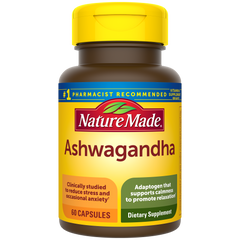
  • Sensoril® Ashwagandha: A clinically studied ashwagandha root and leaf extract that is standardized to 10% withanolides, making it more concentrated than other extracts. In clinical studies, a dose of 125 mg per day reduces stress and occasional anxiety. Nature Made offers a few supplements with Sensoril® ashwagandha, including our Ashwagandha Capsules. Our Magnesium 300 mg + Ashwagandha 125 mg Capsules are another Sensoril® option — combining in 2 capsules 300 mg magnesium to help relax the body with 125 mg of clinically studied Sensoril® ashwagandha to help reduce stress and occasional anxiety, in a melatonin-free, non-habit-forming .

When to Take Ashwagandha?

So, when should you take ashwagandha? We have already discussed that it can help if you are experiencing stress. However, is there a time of day that is best? The answer is that it depends. Ashwagandha can be taken at any time of day that best fits your needs. But there are slight differences depending on the product.

As we mentioned earlier, KSM-66® ashwagandha is clinically studied to help relieve stress, so it can be taken at any time of day but should be taken daily over a period of time to help reduce stress. As an adaptogen, it works with your body over time to support stress resilience and help support sleep quality. If you’re curious about whether ashwagandha makes you sleepy, it doesn’t create the feeling of sleepiness, but over time it can support your sleep quality.

Sensoril® ashwagandha can be taken at any time of day. If you prefer an evening routine, Nature Made Magnesium + Ashwagandha Capsules are a great fit — two daily capsules provide 300 mg of magnesium to help relax the body along with 125 mg of clinically studied Sensoril® ashwagandha to help reduce stress and occasional anxiety. This melatonin-free, non-habit-forming formula can be a simple addition to a wind-down routine without causing drowsiness.

How Long Does Ashwagandha Take to Work?

One of the most common questions people have when starting an ashwagandha supplement is how long it takes to notice results. Because ashwagandha is an adaptogen, it works gradually with your body over time.

Because adaptogens work best over time, taking your supplement consistently each day is key to supporting the best results. With the clinically studied blend of ashwagandha and reishi mushroom found in Ashwagandha + Reishi Mushroom Capsules, people felt noticeably less stressed in as little as 6 weeks.

As with all dietary supplements, individual results may vary. Speak with your healthcare practitioner about what to expect based on your personal health needs.

How to Take Ashwagandha?

When it comes to how to take ashwagandha, always follow the dosage instructions on the label — different products use different types of ashwagandha extract, which means different serving sizes and usage instructions. Dietary supplements might use different types of ashwagandha extracts in their formulation, which results in different dosage amounts and different usage instructions.

A quick note about chronic stress: if you are experiencing chronic stress, meaning you experience stress that persists over a long period of time, then you should consult with your healthcare practitioner about your stress before you consider ashwagandha supplementation or taking any other dietary supplements for stress.

The Bottom Line

Ashwagandha is a plant long revered in Ayurvedic medicine as an adaptogen to help the body adapt to stressors. Whether taken in the morning or at night, ashwagandha helps reduce stress — and the best time to take it is simply the time that fits consistently into your daily routine.

If you’re looking for a supplement that combines ashwagandha stress relief with body relaxation support, Nature Made Magnesium + Ashwagandha Capsules offer clinically studied Sensoril® ashwagandha alongside magnesium to help relax the body — melatonin-free and non-habit-forming formula. Whatever form you choose, speak with your healthcare practitioner to find the ashwagandha supplement that fits your needs.

Learn More About Supporting Your Stress

KSM-66® is a registered trademark of Ixoreal Biomed Inc.

Sensoril® is a registered trademark of Natreon, Inc.


References:

  1. Panossian A, Wikman G. Effects of Adaptogens on the Central Nervous System and the Molecular Mechanisms Associated with Their Stress-Protective Activity. Pharmaceuticals (Basel). 2010;3(1):188-224. Published 2010 Jan 19. doi:10.3390/ph3010188. Accessed on January 28, 2025.

† These statements have not been evaluated by the Food and Drug Administration. These products are not intended to diagnose, treat, cure or prevent any disease.

Authors

Amy Mills Klipstine

NatureMade Sr. Copywriter

Amy has an MFA in Creative Writing from Antioch University in Los Angeles and is a credentialed English teacher, though she left the classroom to write full time. She especially enjoys creating educational content about health, wellness, and nutrition. Her happy place is in the kitchen, and when not writing, you can find her trying out “kid-friendly recipes” and “healthy desserts for chocolate lovers” from her Pinterest board.

Read More about Amy Mills Klipstine

Sandra Zagorin, MS, RD

Science and Health Educator

As a member of the Medical and Scientific Communications team, Sandra educates healthcare professionals and consumers on nutrition, supplements, and related health concerns. Prior to joining Pharmavite, Sandra worked as a clinical dietitian at University of Chicago Medicine in the inpatient and outpatient settings. Sandra received her Bachelor of Science degree in Nutritional Science, with minors in Spanish and Chemistry from the University of Arizona in Tucson, AZ. She earned her Master of Science degree in Clinical Nutrition from RUSH University in Chicago, IL. As part of her Master’s program, Sandra performed research on physical activity participation and correlates in urban Hispanic women.

Read More about Sandra Zagorin, MS, RD