Ashwagandha Roots and a bowl of powder on a wooden surface

Ashwagandha Benefits: What This Herb Does and How It Works†

May 31, 2026 Ashwagandha articles Stress articles
4 MIN

Ashwagandha Roots and a bowl of powder on a wooden surface

Quick Health Scoop

  • The ashwagandha plant (Withania somnifera) is native to India, northern Africa, and the Middle East — its roots and leaves are used in standardized extracts and powders.
  • Used for thousands of years in Ayurvedic medicine, ashwagandha is recognized today through clinical studies for its ability to help reduce stress and cortisol levels.
  • Ashwagandha works as an adaptogen — a compound that helps the body adapt to stressors over time without being a stimulant or sedative.
  • Ashwagandha should not be used by women who are pregnant or nursing, and it's always best to consult your healthcare provider before starting a new supplement.
  • A clinically studied adaptogenic blend of ashwagandha and reishi mushroom reduces stress, and support calm, relaxation and a healthy mood.

If you’re dealing with stress as most of us are, you’ve probably come across ashwagandha. Long revered in Ayurvedic medicine, this small shrub (Withania somnifera) grows in India, the Middle East, and northern Africa and has been used for centuries as an adaptogen: ashwagandha root benefits include a compound that helps the body adapt to stressors over time. While the whole plant is cultivated, it’s the root and leaf that are used in the standardized extracts found in dietary supplements today. In our clinically studied blend, the ashwagandha adaptogen is paired with reishi mushroom, another adaptogenic ingredient. This blend supports stress relief, calm, and a healthy mood.

Ashwagandha Root Benefits: What the Research Shows

Ashwagandha has a long history of traditional use as an adaptogen to help the body adapt to daily stressors. Clinical studies have shown that ashwagandha root extract reduces stress and lowers cortisol levels in the blood — a hormone produced during times of stress.[1,2] These studies used concentrated, standardized ashwagandha extract. Using a standardized herb extract ensures consistency and potency of the active compounds (in ashwagandha's case, the withanolide glycosides). Key benefits of ashwagandha supported by clinical studies include:

  • Helps reduce stress and feelings of occasional anxiousness
  • Reduces blood cortisol levels
  • Supports sleep quality with continued use

How Does Ashwagandha Work?

Ashwagandha is classified as an adaptogen, meaning it works gradually with the body over time to reduce stress rather than producing an immediate effect. Researchers believe ashwagandha acts on the hypothalamic-pituitary-adrenal (HPA) axis — the communication system between the brain and adrenal glands that governs the body’s stress response.[3] When we encounter stress, the body releases cortisol from the adrenal glands. Clinical studies show that KSM-66® standardized ashwagandha root extract helps reduce perceived stress and cortisol levels, supporting a calmer, more balanced stress response over time.

The key active compounds in ashwagandha are called withanolide glycosides. Standardized ashwagandha extracts, like KSM-66® root extract, are measured for withanolide content to ensure potency and consistency per serving.

Ashwagandha and Reishi Mushroom: Benefits of Combining Two Adaptogens

Ashwagandha is increasingly being studied and used alongside reishi mushroom (Ganoderma lingzhi), another adaptogenic ingredient with centuries of traditional use across Asia. Nature Made®’s blend was clinically studied to reduce stress while supporting calm, relaxation and a healthy mood.

In as little as 6 weeks, people who took Nature Made’s Ashwagandha + Reishi Mushroom blend felt noticeably less stressed. The blend works because both ingredients are adaptogens: they help the body adapt to stressors over time without being stimulants or sedatives.

Nature Made Ashwagandha + Reishi Mushroom Capsules provide 600 mg of KSM-66® ashwagandha and 400 mg of reishi mushroom fruiting body extract (standardized to 35% beta-glucans) per 2-capsule serving. Key benefits of this clinically studied blend include:

  • Adaptogenic blend reduces stress and supports calm, relaxation, and a healthy mood
  • Helps reduce cortisol, the stress hormone
  • Daily support for stress and occasional anxiousness
  • In as little as 6 weeks, people felt noticeably less stressed
  • Non-habit forming

How Much Ashwagandha Should I Take Per Day?

Ashwagandha is often consumed in food and tea. If you prefer to take an Ashwagandha supplement, make sure you choose a clinically studied extract. Nature Made Ashwagandha Supplements include clinically studied ashwagandha ingredients to reduce stress. If you are wondering how much Ashwagandha you should take per day, we recommend following the Suggested Use on the label.

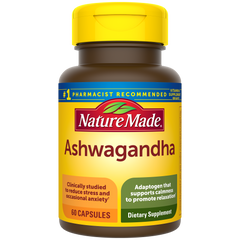
Nature Made offers several ashwagandha options to fit different routines, including Ashwagandha Capsules (Sensoril®, 125 mg), Ashwagandha Gummies (KSM-66®, 300 mg), Magnesium 300 mg + Ashwagandha 125 mg Capsules (Sensoril®, supports stress relief and occasional anxiety), and Ashwagandha + Reishi Mushroom Capsules (KSM-66®, clinically studied blend for stress, calm, and occasional anxiousness).

Who Should Not Take Ashwagandha?

While ashwagandha is generally considered safe for most healthy adults when taken as directed and subject to caution language on the label, it is not appropriate for everyone. The following groups should avoid ashwagandha or consult a healthcare provider before use:

  • Pregnant or nursing women: Ashwagandha should not be used during pregnancy or while nursing.
  • People taking certain prescription medications: If you are taking prescription anxiolytic medications or other medications, consult your doctor before use.
  • Anyone with a chronic health condition: Always speak with your healthcare provider to determine whether ashwagandha is appropriate for your individual needs.

The Bottom Line

Ashwagandha is a traditional herb long revered in Ayurvedic medicine as an adaptogen to help the body adapt to stressors. It is recognized today through clinical studies for its ability to help reduce stress and cortisol levels.

An extract of the roots and leaves of the Ashwagandha plant is used in supplements: look for clinically studied extracts. For other benefits, consider our clinically studied blend of ashwagandha and reishi mushroom to support calm, relaxation, and a healthy mood.

Talk with your doctor before taking a supplement to see if it’s right for your needs. Continue to check back on the Nature Made blog for the latest science-backed articles to help you take ownership of your health.


‡ Sensoril® is clinically studied to reduce cortisol and perceived stress.†

Sensoril® is protected under U.S. Patent No. 7,318,938 and CA Patent No. 2,508,478, and is a registered trademark of Natreon, Inc. 

KSM-66® is clinically studied to help reduce cortisol and perceived stress.† KSM-66® is a registered trademark of Ixoreal Biomed Inc. 


References:

  1. Pingali U, Pilli R, Fatima N. Effect of Withania somnifera on mental stress induced changes in hemodynamic properties and arterial wave reflections in healthy subjects. Current topics in nutraceutical research. 2013; 11:4, 151-158
  2. Indian Journal of Psychological Medicine. “A prospective, randomized double-blind, placebo-controlled study of safety and efficacy of a high-concentration full-spectrum extract of ashwagandha root in reducing stress ... in adults.” July 2012. Accessed on: March 30, 2021. https://pubmed.ncbi.nlm.nih.gov/23439798/
  3. McKinney E, Stewart J, Kewalramani R, Singh S. Effects of multi-herb and ashwagandha root formulas on stress modulation: a randomized, double-blind, placebo-controlled clinical study. Trials. Published online September 2026:10.1186/s13063-02609495-9. doi:https://doi.org/10.1186/s13063-026-09495-9

† These statements have not been evaluated by the Food and Drug Administration. These products are not intended to diagnose, treat, cure or prevent any disease.

Authors

Graham Morris

NatureMade Copywriter

Graham has a degree in film with a focus on screenwriting from the University of California, Santa Cruz. He enjoys learning new things and finding the best, most engaging way to communicate them to a wide audience. Graham appreciates simplicity in life and nutrition, and wants to find the easiest, no-stress ways to stay healthy.

Read More about Graham Morris

Sandra Zagorin, MS, RD

Science and Health Educator

As a member of the Medical and Scientific Communications team, Sandra educates healthcare professionals and consumers on nutrition, supplements, and related health concerns. Prior to joining Pharmavite, Sandra worked as a clinical dietitian at University of Chicago Medicine in the inpatient and outpatient settings. Sandra received her Bachelor of Science degree in Nutritional Science, with minors in Spanish and Chemistry from the University of Arizona in Tucson, AZ. She earned her Master of Science degree in Clinical Nutrition from RUSH University in Chicago, IL. As part of her Master’s program, Sandra performed research on physical activity participation and correlates in urban Hispanic women.

Read More about Sandra Zagorin, MS, RD