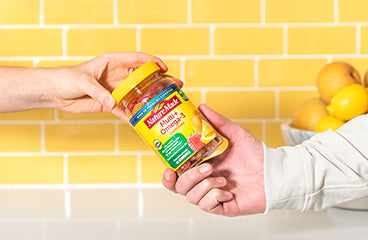
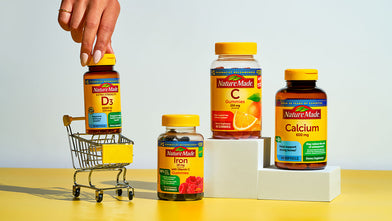
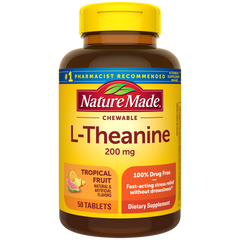
Nature Made Focus Boost Capsules on a kitchen counter.

L-Theanine and Caffeine: Why This Pair Is Often Used Together for Focus

Apr 30, 2026 Brain Health articles Energy articles
5 MIN

Nature Made Focus Boost Capsules on a kitchen counter.

Focus can become a hot commodity in today’s busy, attention-grabbing world, and it’s common for adults to look for ways to support their focus and attention as part of their daily routine. For a combination of ingredients that support focus, you might find two in particular: caffeine and L-theanine.

This pair is naturally found in both green and black tea and works together to help support focus. Nature Made Focus Boost includes a similar ratio of caffeine to L-theanine to that found in tea and provides a convenient way to add them to your daily wellness routine.

What Is L-Theanine and Why Is It Associated With “Calm Focus” 

We’re all familiar with caffeine, but what exactly is L-theanine, and what are L-theanine benefits? Though it might have a slightly more complicated name, L-theanine is an amino acid found in green and black tea leaves (and some mushrooms!).[1]

L-theanine supports calm and focus because it acts on alpha brain waves, which are associated with a relaxed but alert mental state.[2] That state is often described as “calm focus” or “relaxed alertness.”

You might be worried that if L-theanine helps with relaxation, does that mean you’ll get drowsy? No, L-theanine does not cause drowsiness; it supports an alert, relaxed state. Due to L-theanine’s presence in tea, it has long been associated with a different quality of alertness than coffee, which only contains caffeine.

How Does L-Theanine Work? 

L-theanine acts on neurotransmitter activity in the brain, supporting levels of GABA, serotonin, and dopamine, which are associated with mood and relaxation. Research has evaluated L-theanine’s effect on alpha waves, which are associated with a relaxed, wakeful state, which is why it’s associated with “calm alertness.”[2]

L-Theanine Benefits for Focus: What Research Tends to Evaluate 

L-theanine is often studied for its effects on focus and attention along with caffeine L-theanine is most often consumed alongside caffeine because of its complementary presence in black and green tea leaves. 

Research tends to show that L-theanine and caffeine together are associated with improvements in attention-related outcomes compared with caffeine alone or L-theanine alone.[3] Another study indicated that L-theanine and caffeine improved alertness and task-switching capabilities and reduced self-reported tiredness.[4]

So, what’s the other half of the equation look like? What does caffeine do for alertness and attention? 

How Caffeine Supports Alertness and Attention 

Caffeine is already part of many of our morning routines. Whether that’s a hot cuppa joe or hot green tea with breakfast, caffeine is one of the most consumed substances in the world. But what does it do, exactly? Caffeine works by blocking adenosine receptors in the brain.[5]

These receptors, when they receive adenosine, promote relaxation and sleepiness. Which means, when they’re blocked, sleepiness does not build up, and through this mechanism, caffeine helps reduce feelings of sleepiness and supports wakefulness and alertness.[5]

While caffeine is often described as “giving you energy,” it’s important to distinguish that caffeine promotes alertness and perceived wakefulness. Caffeine does not provide any cellular energy, or ATP (Adenosine Triphosphate), which is produced in the body from macronutrients in the diet.[6]

While caffeine can improve morning wakefulness, it’s worth noting some of its downsides. If you consume a higher dose of caffeine, or if you’re a caffeine-sensitive individual, it can contribute to a feeling of jitteriness or restlessness.[7] If you consume caffeine too late in the day, it can also delay the onset of sleepiness, disrupting your regular sleep cycle.[8]

So why is caffeine so often paired with l-theanine for focus?

Why L-Theanine + Caffeine Are Often Paired for Focus 

L-theanine and caffeine often come as a duo. Like peanut butter and jelly. Peaches and cream. Found together in green and black tea leaves, these two ingredients are commonly studied together, and most research and evaluation focus on their combined effects, including improving focus and reducing mental fatigue that may occur due to everyday stressors.[3]†

The two have a proposed complementary relationship, which is what most of these studies focus on. Here’s how it’s thought to work. Caffeine supports your alertness and wakefulness by blocking adenosine, so you feel less sleepy, while L-theanine is known for its calming effect on the mind.[1,2]

Together, this pairing is commonly described as supporting alert focus, without the edginess or jitteriness some people experience from caffeine alone.[2] This pairing has attracted studies that measure sustained attention, reaction time, and mental accuracy during cognitively demanding tasks.[4]†

As stated above, these two ingredients are found together in green and black tea leaves, which may be why tea has often been associated with a different quality of alertness than coffee. The ratio of the two in tea is similar to the ratio in Nature Made Focus Boost Capsules.

Supplements for Cognitive Function Support: How to Choose Responsibly and Use Safely 

There are many supplements out there for cognitive function support, and it’s good to know what to look for when picking the right one for you. Make sure the label clearly lists all ingredients and states the benefits. 

Supplements aren’t shortcuts, and they don’t replace healthy lifestyle choices. But they can provide convenient support for a balanced daily routine that includes adequate sleep, hydration, balanced nutrition, and healthy stress management techniques. 

With any supplement, it’s important to read the label carefully and follow all instructions for use and dosage. For supplements including caffeine, be mindful of your daily caffeine intake. Before starting any supplement routine, consult a healthcare professional if you have any underlying conditions or take medication. 

It’s easy to find a high-quality supplement by paying attention to the label, ingredients, and benefits. Education is an important part of being an informed consumer, which is why Nature Made is dedicated to sharing clear, science-backed information to help you make confident choices. 

Nature Made Focus Boost: A Convenient Option for Supporting Focus and Attention 

If you’re looking for a convenient way to experience the benefits of an L-theanine and caffeine pairing, check out Nature Made Focus Boost Capsules. Just like how caffeine and L-theanine pair well in green and black tea, Focus Boost combines these ingredients in a similar ratio in a convenient supplement format.

This fast-acting supplement works within one hour, with a clinically studied green tea caffeine and L-theanine blend to help reduce mental fatigue and support focus and attention.

In addition to that famous pairing, Focus Boost also includes five essential B vitamins (B6, B12, thiamin, niacin, and pantothenic acid) to support cellular energy production (by converting food into energy) and brain cell function. Pantothenic acid supports the body’s natural response to stress, and vitamin B6 supports the production of mood transmitters needed for mood health.

One daily capsule is a convenient way to supplement a balanced daily routine, complementing healthy habits like adequate sleep, balanced nutrition, regular physical activity, and hydration.

Check out Focus Boost Capsules today and explore our Brain Health Supplements. Nature Made is the #1 Pharmacist Recommended Vitamins & Supplements Brand.*


* Based on a survey of pharmacists who recommend branded vitamins and supplements


† These statements have not been evaluated by the Food and Drug Administration. This product is not intended to diagnose, treat, cure, or prevent any disease.


References:

  1. Anas Sohail A, Ortiz F, Varghese T, et al. The Cognitive-Enhancing Outcomes of Caffeine and L-theanine: A Systematic Review. Cureus. 2021;13(12):e20828. Published 2021 Dec 30. doi:10.7759/cureus.20828
  2. Dashwood R, Visioli F. l-theanine: From tea leaf to trending supplement – does the science match the hype for brain health and relaxation? Nutrition Research. 2025;134:39-48. doi:https://doi.org/10.1016/j.nutres.2024.12.008
  3. Hidese S, Ogawa S, Ota M, et al. Effects of L-Theanine Administration on Stress-Related Symptoms and Cognitive Functions in Healthy Adults: A Randomized Controlled Trial. Nutrients. 2019;11(10):2362. Published 2019 Oct 3. doi:10.3390/nu11102362
  4. Giesbrecht T, Rycroft JA, Rowson MJ, De Bruin EA. The combination of L-theanine and caffeine improves cognitive performance and increases subjective alertness. Nutr Neurosci. 2010;13(6):283-290. doi:10.1179/147683010X12611460764840
  5. Fiani B, Zhu L, Musch BL, et al. The Neurophysiology of Caffeine as a Central Nervous System Stimulant and the Resultant Effects on Cognitive Function. Cureus. 2021;13(5):e15032. Published 2021 May 14. doi:10.7759/cureus.15032
  6. Judge A, Dodd MS. Metabolism. Essays Biochem. 2020;64(4):607-647. doi:10.1042/EBC20190041
  7. Karolina Knychalska, Sikora J, Mikołaj Łabuda, et al. The Impact of Caffeine on Anxiety Levels and Stress Responses - a literature review. Journal of Education Health and Sport. 2025;81:59947-59947. doi:https://doi.org/10.12775/jehs.2025.81.59947
  8. O'Callaghan F, Muurlink O, Reid N. Effects of caffeine on sleep quality and daytime functioning. Risk Manag Healthc Policy. 2018;11:263-271. Published 2018 Dec 7. doi:10.2147/RMHP.S156404

Authors

Graham Morris

NatureMade Copywriter

Graham has a degree in film with a focus on screenwriting from the University of California, Santa Cruz. He enjoys learning new things and finding the best, most engaging way to communicate them to a wide audience. Graham appreciates simplicity in life and nutrition, and wants to find the easiest, no-stress ways to stay healthy.

Read More about Graham Morris

Sandra Zagorin, MS, RD

Science and Health Educator

As a member of the Medical and Scientific Communications team, Sandra educates healthcare professionals and consumers on nutrition, supplements, and related health concerns. Prior to joining Pharmavite, Sandra worked as a clinical dietitian at University of Chicago Medicine in the inpatient and outpatient settings. Sandra received her Bachelor of Science degree in Nutritional Science, with minors in Spanish and Chemistry from the University of Arizona in Tucson, AZ. She earned her Master of Science degree in Clinical Nutrition from RUSH University in Chicago, IL. As part of her Master’s program, Sandra performed research on physical activity participation and correlates in urban Hispanic women.

Read More about Sandra Zagorin, MS, RD